Friday, March 14, 2008

Aaron's Picks of the Year: Top Seven of Oh Seven (part 2)

You can check out picks 7-4 in my last post.

3. Y the Last Man #58

by Vaughan (w) and Guerra (a)

I realize that my past few picks have all been "moment" issues, and by that I mean issues that are pretty cool in their own right, but have one particular moment that makes you go "holy [crap]" and sticks with you for a long time afterwards. Well, Y the Last Man #58 is another one of these "moment" issues, but it's the last one, I promise. In terms of moments, though, this issue probably delivered the most gut-wrenching (and rewarding) one of the year.

What exactly happens? Well, I'm not going to say, because if you haven't read it yet you'd be doing yourself a criminal disservice not experiencing it for yourself, and if you have you know exactly what I'm talking about. All I'm going to say is that Y the Last Man #58 is a testament to putting a time limit on a comic series (as opposed to continuing them indefinitely), as it allows you to get away with moments like the one found in this issue. Oh, and I'll also say that the moment in question is not only shocking in and of itself, but it's executed beautifully with expert pacing, and artist Guerra's mastery of conveying expression. The final shot in this issue left me with no small amount of goosebumps, and the odd tear.

But okay, let's look at the issue as a whole. The last four pages aside, Vaughan does a very good job building up this series to its inevitable conclusion, while still throwing in both twists and some solid character moments, such as Agent 355's scene in the dress shop and Yorick's moment with Beth. There's a feeling of suspense that's pretty much been creeping through the story for the past 3 or so issues, and #58 continues that feeling perfectly, so that readers find themselves unable to handle the thirty day wait before #59 (which was good as well, but failed to live up to this one).

While I'll admit that issue #60 (the final issue), which came out in 2008, was a better issue overall, it's going to be the events of issue #58 - the climax of the series - that people will talk about for years to come. Read this issue for yourself, but before you do, read issues #1-57 first.


2. The League of Extraordinary Gentlemen: Black Dossier

by Moore (w) and O'Neill (a)

Quite frankly, I'm surprised this book hasn't made that big of a splash since its release. I mean, the fact that it's a new Alan Moore book alone should have been enough to get people talking, never mind the absolutely innovative approach he's taken here. One thing that makes Moore such a great writer, in my opinion, is the fact that he's always trying to challenge himself and push storytelling in new ways, and Black Dossier is probably the strongest example of this I've seen to date.

And okay, innovative is one thing, but it's not enough (like, innovative can still suck). But Black Dossier is also good. Really good. Italics good.

One of the main elements of Black Dossier, and indeed the entire League of Extraordinary Gentlemen series, is that all the main characters (actually, all the characters period) are literary figures. As with earlier incarnations of the League (see volumes one and two), Moore has developed a rich continuity that incorporates countless characters from literary (and a few other pop culture) sources, but does so in a way that feels natural, so you may be introduced to a character from, say, a 1940s serial and not even realize it. This is sort of refreshing when compared to most stories that try to do the same sort of thing without the subtlety. Sure, it works okay in Shrek and Fables, but remember those cringe-worthy scenes in Shanghai Knights when like Jackie Chan and Owen Wilson would meet someone and then the audience would find out that the person was historically significant (eg Charlie Chaplin and Arthur Conan Doyle) like it had anything do to with anything? Also, the main villain's name was Rathbone, if I remember correctly. Don't see Shanghai Knights.

But yeah, Moore (and O'Neill) do a great job fitting in hundreds of clever references, only a small percentage of which I actually caught. But the beauty of it is that, while it always feels cool to catch a reference in a sort of "ohh hey!" moment, the references that fly over the head don't detract from the story. In fact, part of the fun of this story was logging on to Wikipedia after every sitting and checking up on references I didn't get at first.

You may have noticed I referred to sittings in the last paragraph. That's because this book takes quite a while for the average reader to finish. It took me almost a whole week, and I tore into this voraciously. This is a welcome change of pace for people who are used to finishing a comic in about 10 minutes, or a graphic novel in about an hour. Reading this book is more of an experience. This is partly because, as in Watchmen, Moore switches between the story itself and "firsthand documents" from within the story. Only this time, Moore has sought to emulate the works of those before him in these documents, with truly impressive results. For example, there is a "lost folio" of a Shakespeare play involving characters from League that hits all the right notes of a Shakespeare play. Or a story where the League meet Jeeves and Wooster that feels like it was written by P.G. Wodehouse. The Sal Paradise section, however, was apparently not very convincing (according to my dad; I never read any Jack Kerouac, and still thought the section itself was really cool). Still, this created a very cool reading experience, and one that took a lot longer to get through. Also, there's a very awesome, albeit gimmicky, sequence at the end that made me very happy (hint: it involves 3-D glasses).

My one, one complaint with the story is with the final monologue of the story, which didn't ring true to me; more particularly, it felt unnecessary. I don't want to give too much away, but basically one of the characters turns to the audience and says "we're all fictional characters. We live in the imagination and we're significant in the development of humanity." That's a pretty glossed-over account, but it's essentially what I took with me from it. This sequence, as I mentioned, didn't do much for me, and actually hindered the story a little bit, as it drew unneeded attention to the man behind the curtain. The message itself felt like it had already been said in some capacity in - oh, I dunno - like every issue of Sandman.

Still, this was truly a unique book, one that immersed me when I read it and has stuck with me ever since. I really don't know why it hasn't been talked about more, though I do suspect it might have to do with its scarcity in Canada - the comic shop I frequent had to smuggle it in for me, which is why they charged me extra (at least, they told me they smuggled it in). It was worth the extra charge. This is one of my favourite hardcovers of all time.


1. X-Factor #16

by David (w) and Raimondi (a)

This won't be as long as my spiel on the Black Dossier, not because there's less to say about it, but because I read this story way back in February 2007 and don't have a copy of it on me, so I'm mostly speaking from memory. But anyways, X-Factor has been one of my favourite comics since issue #1 of the new series (though my love originated in Davd and Raimondi's Madrox miniseries). The stories have been interesting, the dialogue has some of the wittiest banter I've read in a comic (rivaled by maybe Joss Whedon), and the characters are incredibly charming, especially through their flaws. There have been a few hiccups along the way, admittedly. I wasn't a fan of how abruptly they got rid of interesting antagonists Singularity Investigations in the first arc, and the issue where Syrin is captured by that crazy guy didn't really hit the right notes with me. The inconsistency of the rotating artists (sometimes within an individual issue) got pretty distracting as well. That being said, though, issue #16 was executed perfectly, and has stood out ever since as one of the strongest individual issues of a comic that I've ever read.

The premise itself is interesting: previously, Jamie Madrox (aka Multiple Man), in what can only be described as hardcore multitasking, had created copies (or "dupes") of himself and sent them out into the world. The dupes would gain experience in various areas of life (such as detective work, or becoming a Shaolin monk) before returning for him to absorb them, along with their newfound experience. However, some of the dupes had become unreliable, and Madrox had resolved to go around and collect as much of "himself" as possible. This issue deals with him meeting one such dupe who had gone off, become a man of God, and started a family. What's more, the dupe will do everything in his power to avoid being reabsorbed.

So already we have a very intriguing conflict that incorporates superheroic elements, but addresses it in a very human way; for example, the story could have stood on its own, with only minor changes, as a tale of a man living on borrowed time, preparing for his own demise (think Everyman). There are a lot of moral and spiritual questions that poke themselves into the story: does the dupe has a right to stake his own claim in the world, at the expense of Jamie's fractured identity? Is borrowed time a blessing or a curse? All this is a metaphor for something... isn't it? David, obviously aware of these issues, complicates them by really humanizing the dupe. If, say, the dupe had been treated like a one-note character (like most of the other dupes), a lot of these underlying issues would be lost.

But instead, we get to see this dupe (James Maddocks) as a human being with a full range of emotions. We meet his family, we hear him talk about religion and philosophy, and wrestle with the implications of Jamie's arrival into his town. David really lets us get into James' mind, so that at the climax of the issue, when James is caught between conflicting ideological and self-preservationist instincts, and makes a decision that effectively seals his fate, the reader is heartbroken (this reader was, at least).

David and Raimondi have created a standalone thought-provoking story that spans a wide emotional spectrum, and they've done it in 22 pages. This issue really is an example of what the medium can accomplish - even in something as goofy as a super hero comic.


If you read this list and disagreed with my choice of the top 7 of 07, feel free to comment with what you feel was left out, or why not share with us your own list?

Thursday, February 28, 2008

Aaron's Picks of the Year: Top Seven of Oh Seven (part 1)

Over on the Comic Book Syndicate's facebook group, members were asked to come up with their "Top Seven Comics of 2007". Naturally, I rose to the challenge and produced a list with which I was fairly happy. So I figured what the hey, it's Leap Day, so why don't I do something different and update my blog?

So here they are, my Top Seven comics of the year, in reverse order.

7. Star Wars: Legacy #15

by Ostrander (w) and Duursema (a)

After Star Wars Episode III hit theatres, a lot of Star Wars fans (myself included) were depressed for two reasons.

1) It sucked.

2) It was the final Star Wars movie for a long, long, time... perhaps ever.

This wasn't to say that there would no longer be any new Star Wars stories. I had been, after all, a longtime fan of the Star Wars comics and, to a lesser degree, the novels. But these stories always felt like they were traipsing around the bigger events (the movies). Whereas the movies gave us universe-shattering events, entire planets getting demolished, and Jedis dying in the thousands, the comics would have to focus on the more... fringier characters, doing more fringier things. We'd be treated to such stories as "Watto builds a new podracer," "Mace Windu trains an eager new padawan," or "Baboon-Ass-Faced Alien and the Hidden Library."

Well, for those still worried that there will never be another Star Wars story that could match the epic scope of the movies, you need look no further than Star Wars: Legacy. While the idea of "Star Wars 100 years in the future" may stink of "Archie 3000," the series so far has been nothing short of adventurous, dark, funny, clever, and in the case of issue 15's Darth Krayt reveal, really fucking cool.

And, oh yeah, epic.


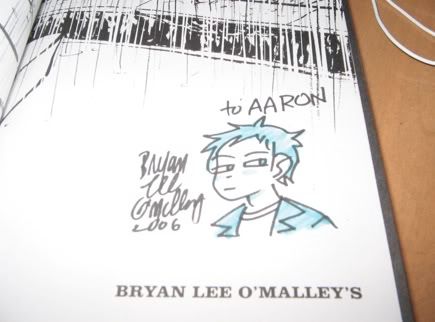
6. Scott Pilgrim Gets it Together

by O'Malley (w and a)

See my last post.


5. Sinestro Corps Special #1

by Johns (w) and Van Sciver (a)

As far as DC superheroes go, I'd have to say that Green Lantern has always struck me as one of the least interesting heroes, next to perhaps Superman. I don't really think that the characters are lame in themselves, just that maybe their corner of the DCU doesn't necessarily appeal to me. Of course, that's the great thing about DC and Marvel Comics: the sheer variety of their superheroes assures that while not every superhero will appeal to you, at least one will. So, while I can enjoy the latest adventures of heroes such as Batman, Animal Man, and Plastic Man (probably my top 3 DC characters), I can at the same time leave Green Lantern be in his little pocket of space.

So you can guess how good this book must be to make the top 5, considering how few shits I give about the character.

But then again, as little as I've cared about Green Lantern, I've always had a soft spot for Sinestro, who I've always considered to be his arch-nemesis (his Joker, if you will). He's always struck me as the Dick Dastardly of the DCU, so it's nice to see him really get his due in this issue. Let's not forget the completely jaw-dropping reveal of the identities of the Sinestro Corps Guardians.

At the end of the day, this book didn't really make me care about any of the Lanterns any more than I used to, but introduced a massive threat to the DCU that I hope remains in some capacity for years to come.

4. Buffy the Vampire Slayer Season 8: #3

by Whedon (a) and Jeanty (a)

You know how I said the problem with most Star Wars comics is that they sort of have to tiptoe around the established continuity? Well Buffy has no such reservations. In fact, it's gone one step further and become the authoritative source of all things Buffy, killing off characters, bringing other characters back, etc. This series calls itself Season 8, and it certainly has acted as such. If anything, Buffy the comic is functioning even more effectively than Buffy the show can, in that the content suits the medium better than a reasonably budgeted television show ever could (compare the extravagant monsters in the comics to, say, the goofy CGI'd beasts of the show and you'll know what I'm talking about).

Prior to issue three, this just read like a solid series, and not much more. The reveal at the end of this issue, however, in addition to being perhaps my favourite moment of 2007, really solidified in my mind that this book functions not only as a supplement to the show, but as an integral force in its own right, and a must for any Buffy fan.


Next Up: picks 3 to 1

Tuesday, November 20, 2007

Aaron's Pick of the Week: I've Liked You for a Thousand Years

For the week of November 14:

Scott Pilgrim Gets it Together

by O'Malley (w and a)

A lot of people think of comic books as a form of escapism. And I guess that makes sense, as the top comic books tend to be about people who can fly, shoot lasers out of their eyes, sling webbing from their wrists, or be blind but not really.

But then again, comic books, like any medium, can't be summed up in just one category (other than "awesome"). Just as movies aren't just about fantastical events but a whole array of subjects, there are some comics out there that focus on the more everyday aspects of life, such as getting a job, paying rent, and maintaining a steady relationship (although, come to think of it, only one of these things apply to me at the moment). Granted, these stories are somewhat hard to find in the mainstream world of comics. Which makes books like the Scott Pilgrim series all the sweeter.

As you can probalby tell from the image of the cover, this is the fourth installment of Brian Lee O'Malley's indie gem. I was first exposed to Scott Pilgrim in my first year of university, and was initially turned off by the "Anime" style of the art (because I was dumb). Still, by the time I got about 20 pages in, I was hooked (you can be too! Check out the free previews here). The art, while maybe too "cutesy" for some, really served the story well rather than complicating things, and was actually fairly intricate, as backgrounds sometimes proved.

This is a series with a lot going for it, from the art, to the storyline (a fairly straightforward coming-of-age story with many unique storytelling approaches), to O'Malley's excellent sense of humor.

For me, though, the number one draw has always been how damn relateable the book is. Scott Pilgrim is a mostly-directionless 23-year-old who's pretty much just starting to figure out how the world works, all the while juggling his social, romantic, and (somewhat) professional life. While there are a multitude of differences between the characters and myself (for example, I am 21, still in university, and can't play a musical instrument to save my life), I still identified with the characters on a level I hadn't with previous works that "spoke to a generation," such as Clerks, Garden State, or, uh, Degrassi High. As I was reading this book I constantly had to stop and note all the similarities between certain characters and existing friends of mine (that's right, existing). It probably helps that the series takes place in Toronto, where I grew up. Many locations, such as Sneaky Dee's and Lee's Palace, are featured in this series, adding to the "oh hey, just like MY life" factor.

This isn't to say that Scott Pilgrim is completely "slice of life." A lot of the storytelling is very over-the-top, completely abandoning concepts like "realism." At the same time, however, these over-the-top moments are told honestly and come from a real place, and therefore don't detract from the relateability. For example, an ongoing plotline throughout the series is that Scott must vanquish his girlfriend Ramona's Seven Evil Exes, and these scenes are usually depicted in a style similar to that of a video game. While this is obviously not a common thing most people have to deal with, anyone who's had a girlfriend (or boyfriend) probably knows that often, past exes can leave a "lingering" effect on new relationships, one that isn't necessarily welcome.

I often recommend comic books to other people, but it's not very often that I push them on non-comic-book fans. The Scott Pilgrim series is one very notable exception. I recommend this series (don't start with volume 4, as great as it is) to anyone who feels as if they're trying to figure out their place in life, or that no one can relate to what they're going through. And that's, what? Everyone?

9.4 out of 10


All interior shots (except for the last one) taken from Brian Lee O'Malley's flickr account.

Monday, November 12, 2007

Aaron's Pick of the Week: Joss Whedon is My Master Now

For the week of November 7:

Astonishing X-men #23

by Whedon (w) and Cassady (a)

As I headed to my local comic book shop last Wednesday, I walked with an unusual bounce in my steps. This week was a particularly heavy week in terms of quality books, with such titles as Y: the Last Man, Criminal, Buffy the Vampire Slayer, Hellboy, and Super-Villain Team-up. Each of these books are Pick-of-the-Week-worthy on their own, and the fact that they all came out on the same day means good times for the reader.

Of all the comics I was hoping to pick up, only Joss Whedon’s Astonishing X-men #23 was sold out before I got to the store. I didn’t think too much of this at the time, as I had all those other titles to keep my mind occupied.

And keep my mind occupied those other titles did. For the most part, these titles really delivered, and I had decided that my Pick of the Week was to be Criminal #10, by Ed Brubaker and Sean Phillips. I had written about half of the review in my head, however, before I managed to get my hands on Astonishing X-men while in Toronto. I read it, and knew I had to rewrite my post.

Keep that in mind: Astonishing X-men #23 was so good that I was willing to completely abandon my original Pick of the Week just so I could talk about it.

Usually, when people ask me what I think of the X-men at the moment, I screw up my face and say something like “blech.” And that’s because, for the most part, X-men have been terrible for quite some time (note: when I refer to X-men I am referring to the “X-titles,” which include Uncanny X-men, X-men, New X-men, X-factor, Excalibur, and the up-and-coming X-force, not to mention various mini-series and one shots). One exception to this rule is X-factor, which is actually incredibly good.

Oh, and then there’s Astonishing X-men.

Joss Whedon’s been responsible for some of my favorite television shows (Buffy and Firefly), and I’ve always had a soft spot for his snappy dialog, so when in 2004 I heard he would be writing his own X-men book I was somewhat intrigued. At the same time, though, I was aware of the fact that a good writer of one medium is not always going to translate well into a different one. An example of this is Orson Scott Card who, despite his wonderful work on the fan-favorite Ender novels, went on to write the lackluster Ultimate Iron-man.

But Joss Whedon proved early on in his series that he wasn’t just a good television writer. He was a good writer period. From what I’ve witnessed from his comic book career, not only in Astonishing but in titles like Runaways and Buffy, Whedon has shown that he’s done his research and understands what makes the graphic novel medium unique. He is able to manipulate dialog in ways that an auditory medium (like TV, where you don’t see, but rather hear the dialog) would not be able to capture. By using techniques like removing punctuation in parts or otherwise playing with the appearance of the words, he makes the dialog more effective than it could be in any other medium.

That’s just one of the many techniques Whedon has used in the past – techniques that I had never seen before reading his comics, and ones that have left a lasting impression on me. In Astonishing X-men #23, Whedon uses another technique that I have never seen before, and frankly left me stunned. I don’t want to give too much away, but this issue contains a very interesting plot twist that, once again, would not nearly be as effectively conveyed were it not written for the medium of comics. It involves a page from issue #22 replayed panel-by-panel, only thought balloons replace word balloons and… ah, you have to see it for the full effect.

Even if you’re not a huge nerd like me, and don’t give a crap about “techniques” that Whedon employs, this issue still delivers in terms of action and especially characters. One of my other favorite things about this run is that Whedon took Cyclops, a character who has been considered “lame” for quite some time (but not by me!), and made him really, really, cool. The final action sequence of this book depicts probably the most impressive Cyclops moments since… ever. The final page sent shivers down my spine, although I’ll admit it could have been one thought balloon shorter for maximum effect.

None of this could be possible, however, without John Cassady’s beautiful artwork, which hopefully you are experiencing through the images I included (all taken from Comic Book Resources). He’s one of those rare comic book artists who is a perfect blend of dynamic artwork and crisp storytelling (you’d think it would be a given, but it’s actually something you come to appreciate in the world of comics). It makes the fact that this book only comes out once every 2-3 months almost worthwhile.

That’s pretty much my biggest complaint with this book. It doesn’t come out often enough, and I don’t just say that because I’m impatient. The book’s slow schedule means that it takes 2 years for a storyline to conclude. Unfortunately, it’s very hard to keep me excited for such an extended period of time. But then again, all it takes is an issue like this to make me a gushing fanboy again.

Oh, and I’m going to start having a ratings system from now on, out of ten (with decimals), because why not?

RATING: 9.7

Friday, November 9, 2007

Trailer Trash

Last week I was lounging around on campus with a friend while she was on the computer. She was reading the celebrity gossip blog PerezHilton and as I glanced at her computer, a post about Angelina Jolie caught my eye.

Me: What's that?

Her: Oh, just a post about Angelina Jolie.

Me: What about her?

Her: Nothing really, just that there's a new trailer for her upcoming movie.

Me: Oh. Beowulf?

Her: No... (looks at post again) something called Wanted.

Me: (pause) What did you say?

Her: Some movie called Wanted.

Me: ...and the trailer's out?

Her: Apparently.

Me: Let me use your computer.

Her: Uh, what fo-

Me: LET ME USE YOUR FUCKING COMPUTER!

um... Perhaps some context is needed. Wanted was a 6-issue comic miniseries written by Mark Millar that ran from 2003-2004. The London Sunday Times allegedly dubbed it "the Watchmen for super-villains" and while I wouldn't necessarily go that far, I can certainly agree that it was one of my favorite books at the time. It was about a young loser who is pulled out of his mundane life of obscurity and obedience when he finds out that his father was the greatest super-villain of all time.

The story was clever, tense, humorous, and had amazing art by J.G. Jones. What's more, Wanted was unique, with interesting characters - each a rift on archetypal super-villains (like Catwoman and The Joker), only approached in new and colorful ways. It was through these characters that the book truly shined.

Which only made me more confused when I saw this garbage trailer:


"Where are the costumes?" I asked my friend, who was beginning to get a little scared. "Where are the colorful characters? The witty dialog? Hell, where's anything that would have me believe this isn't just a generic shoot-em-up piece of crap?"

They certainly aren't in this trailer, I told myself. I nodded.

A few days later I went and saw American Gangster with my comic-loving friend Michael and this trailer started playing. I turned to him and asked him if he knew what the trailer was for. He replied that it looked like the sequel to Mr. and Mrs. Smith, which was, let's face it, a generic piece of crap to begin with.

As much as I want to see Mr. Tumnus running around shooting people (not at all), I don't think I will be catching this one in theaters. I know the term "Hollywood-ized" gets thrown around a lot (at least, I think it does), but this is perfect example of Hollywoodization. It's like if they made a Batman movie, only he didn't wear a costume and instead went around shooting bad guys, and every time he shot someone he'd say some cheesy one-liner, like "Paper or Plastic?"

Wait, that's an awesome idea.

-A

Next up: Enough about comic book movies. Aaron's Pick of the Week.

Edit: In a rare turn of events, myspace appears to have actually done something cool. Thanks to them you can now download the entire first issue of Wanted here. How about that?

Thursday, November 8, 2007

Get a WIFF of this (if you Cannes)....

People who visit this site will probably know that I've blogged about comic book movies a few times in the past, rarely with anything particularly good to say about them as a whole. However, as I've also mentioned, the poor quality of your typical adaptation never stops me from getting excited about the upcoming movies anyway. This time, though, I'm pretty sure I'm not just gearing up for another suckfest.

This weekend, Windsor will be having its 3rd annual International Film Festival (lovingly referred to as WIFF). Of all the films being shown this year, the one I am most eager to see is Persepolis, an animated feature based on Marjane Satrapi's critically-acclaimed graphic novels.


The movie has played at several film festivals, including Cannes, where it won the Jury Prize (I don't know what that means, but I bet it's a good thing). Like many foreign movies, it hasn't seen widespread release. You can probably imagine my excitement, then, when I heard it was playing in my town.

You can probably also imagine my frustration when I heard I would be out of said town when the movie plays.

Don't make the same mistake I did. For those of you living in Windsor who aren't busy this Saturday, take my advice: go see this movie. Let me live vicariously through you. Please?

Persepolis is playing this Saturday, November 10, at 5:00pm at the Windsor Armouries. Tickets are 10 dollars. For more info on the WIFF, you can read Erica W's post or check out the official site.

image taken from Sony's official Persepolis site (linked in text).

P.S. I know I keep coming back to the topic of comic book movies, but I thought it important to talk about Persepolis for this post, both because of its impending screening as well as what its doing for comic book movies (ie, allowing the public to see them as Art-with-a-capital-A). If the next few comic book movies are as mature as this one appears to be, and are received with as high acclaim, I can see only good things for the genre.

Next up: I look at the piece of shit trailer for Wanted.

Sunday, November 4, 2007

5 Quick Questions with Jeff Lemire

This weekend I attended Windsor's annual Bookfest, which is essentially a festival celebrating literature of all sorts. Over the weekend, I saw a few different talks and readings, but the one panel that was a must-see for me was Getting Graphic, which not only examined the graphic novel but also gave some insights into life as an independent comic creator. The panel speakers were Michèle Laframboise, George Rizok, and Jeff Lemire. Having read Tales from the Farm a few days ago, I was only familiar with Jeff Lemire's work, of the three speakers (although now I definitely want to check out the other two). I really really enjoyed his book (one of the only comics out there that actually moved me to tears... but shh), so Lemire was a huge draw for me.

The panel was pretty informative, and really allowed the audience to understand what the life of a comic creator was like, covering topics such as the underground scene, fan interaction, artistic collaborations, and those late nights at Kinko's (bottom line: don't become a comic creator for the money).

After the panel I quickly went and purchased Lemire's follow-up comic, Ghost Stories, from the gift shop. As he signed my copy, I asked him if I could quickly interview him for the blog, to which he kindly agreed.


Blogs of Future Past: What was it that drew you to comics?

Jeff Lemire: I don’t know what it was. I guess it was just the drawings. I remember being really young and going in to get groceries with my mom and just being captivated by the magazine rack and the comics. As soon as I was able to recognize them, I was always drawn to them. I can’t say what it is. (laughs)

BoFP: What inspired you to write “Tales from the farm?”

JL: I think I really wanted to try to tell a little bit more personal stories. So many comics are set in urban centers and cities and stuff. I thought, there’s not enough stories set in rural areas. Especially since I came from here, I thought I’d have an interesting perspective on it and I could draw from some of the details. So I wanted to set a story in a rural setting, and it just seemed natural to create a character who was sort of like I was as a kid, and I’d fictionalize everything else.

BoFP: Are there any comics that you’re reading right now?

JL: My favourite comics right now are The Walking Dead, anything Ed Brubaker’s doing – Captain America, Iron Fist, Daredevil, Criminal – All Star Superman’s amazing, and Scalped by Jason Aaron. He’s my favourite writer right now. I think that guy’s going to be a star. Scalped and The Other Side [also by Aaron] are just brilliant.

BoFP: If you could take over a comic book character, would you? If so, which character would it be?

JL: Yes! I’d love to get a crack at a bunch of characters but my favourite guys are always the DC Silver Age characters. I’ve always had a really strong connection to Adam Strange for some reason. I love Adam Strange and also the Unknown Soldier. I have so many stories I could do with that guy.

BoFP: Finally, what advice do you have for any up and coming comic creators?

JL: I think the biggest thing is that if you’re a writer and not an artist, you know, team up with someone so you can do a book. Just do it, and print it yourself and get it out there. The easiest way to get people in the comic book industry to notice you is not to tell them about what a great writer you are or artist you are, but to show them a book that they can see. You have to start somewhere, so just self-publish and start doing it.


You can check out Jeff Lemire's personal blog here.